EPF Contribution for Age Above 60: Rates, Table & Rules

Turning 60 does not switch off your EPF. It only changes the numbers.
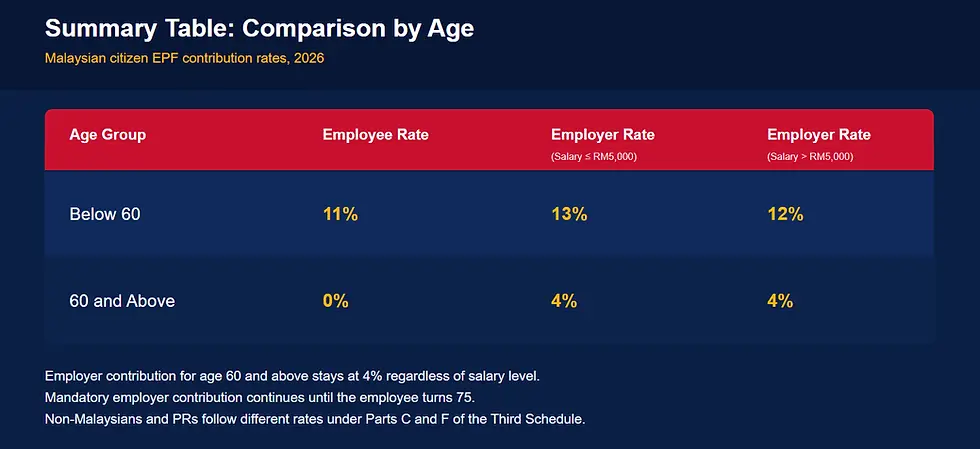
If you are a Malaysian employee aged 60 and above, the mandatory EPF contribution is 0% from you and 4% from your employer.
Nothing gets deducted from your salary anymore, but your employer must still pay into your EPF account every month. This continues until you reach 75, the maximum EPF contribution age.
This guide explains exactly how the EPF contribution for age above 60 works. You will see the current rates, the contribution table, real salary examples, and the separate rules for permanent residents and non-Malaysian workers. If you handle payroll, you will also learn when to change the rate and how to calculate the exact amount without mistakes.
What Is the EPF Contribution Rate for Age Above 60?

The EPF contribution rate for age above 60 is 0% from the employee and 4% from the employer for Malaysian citizens. The employer pays every month even though nothing is deducted from the worker's salary. Contributions can continue until age 75. Permanent residents and non-Malaysian workers follow different rates.
Here is the full picture for the Employees Provident Fund, better known as KWSP:
Category | Employee share | Employer share |
Malaysian citizen, age 60 and above | 0% | 4% |
Permanent resident, age 60 and above* | 5.5% | 6.5% or 6% |
Non-Malaysian member registered from 1 August 1998 | 2% | 2% |
*This row also covers certain non-Malaysian members who registered before 1 August 1998.
A few details matter here:
The official term in the Third Schedule of the EPF Act 1991 is "age 60 and above"
The reduced rate starts in the calendar month after your 60th birthday
Contributions can continue until you turn 75
The current schedule applies from October 2025 salaries (November 2025 contribution month) onwards
EPF Contribution for Malaysian Employees Aged 60 and Above
For Malaysian citizens, the math is simple. You pay nothing. Your employer pays 4% of your wages.
If you earn RM3,000 a month, roughly RM120 goes into your EPF from your employer's pocket. Your payslip shows no EPF deduction at all.
Why does the law work this way? Two reasons.
First, it protects your take-home pay. Workers at this age often already receive a pension or live partly on their savings. Removing the 11% deduction puts more cash in your hand every month.
Second, it lowers the cost of keeping older staff. Paying 4% instead of 12% or 13% makes it cheaper for companies to hold on to experienced workers. That was the goal when the minimum retirement age was raised to 60.
EPF Contribution for Permanent Residents Aged 60 and Above
Permanent residents keep the old-style rates even after 60. The employee share stays at 5.5%, and the employer pays 6.5% for wages up to RM5,000 or 6% for wages above RM5,000.
So unlike Malaysian citizens, a PR employee still sees an EPF deduction on the payslip after turning 60. The exact amount is read from the wage-range table in the Third Schedule.
EPF Contribution for Non-Malaysian Employees Aged 60 and Above
Non-Malaysian members who registered with EPF from 1 August 1998 pay a flat 2% employee share and 2% employer share, and age does not change these rates.
Foreign workers registered before that date may fall under the PR rates instead. Because this depends on your registration date and status, confirm your exact category with KWSP before running payroll.
What Is the EPF Contribution Table for Age Above 60?
The contribution table is where most people get confused, because EPF does not always use a straight percentage.
Two calculation methods exist, and your wages decide which one applies:
Wages of RM20,000 and below: the amount is read from the official wage-range table in the Third Schedule
Wages above RM20,000: the percentage is calculated directly, which means a 4% employer share for Malaysian employees aged 60 and above
Also note that EPF wages cover more than basic pay. Most allowances, commission and bonus count as wages, though items like travel allowances are excluded.
Here are examples based on the current schedule for a Malaysian employee aged 60 and above:
Monthly wages | Employee share | Employer share | Total contribution |
RM1,000 | RM0 | RM40 | RM40 |
RM2,000 | RM0 | RM80 | RM80 |
RM3,250 (official example) | RM0 | RM131 | RM131 |
RM5,000 | RM0 | RM200 | RM200 |
RM10,000 | RM0 | RM400 | RM400 |
RM20,000 | RM0 | RM800 | RM800 |
RM21,250 | RM0 | RM850 | RM850 |
For wages up to RM20,000, the exact amount comes from the wage-range table, so the final figure can sit slightly above a straight 4% calculation. That is exactly why RM3,250 produces RM131 instead of RM130.
For the complete wage-by-wage breakdown covering every age group, see our EPF contribution table 2026 guide.
Why RM3,250 Gives RM131 and Not RM130
Look closely at the table above. Four percent of RM3,250 is RM130, yet the official KWSP example shows RM131.
The reason is the wage-range method. Instead of making payroll staff calculate sen-level amounts, KWSP groups wages into small ranges and fixes one contribution amount for each range. The amounts are rounded up to the next ringgit based on the range, not on your exact salary.
This is why you should never rely on a simple 4% multiplication for wages of RM20,000 and below. Always read the amount from the official table.
How Wages Above RM20,000 Are Calculated
Once wages pass RM20,000, the wage-range method stops and the percentage method takes over. The employer simply pays 4% of the full wage.
Example: RM21,250 x 4% = RM850.
There is also no wage ceiling for EPF. Whether the monthly wage is RM21,000 or RM50,000, the employer pays 4% on the entire amount for employees in this age group.
Does EPF Contribution Continue After Age 60?
Yes, it does. EPF does not stop at 60. It only changes gear.
As long as you stay employed, your employer keeps paying the 4% share every month until you reach the maximum contribution age of 75. Your own mandatory share simply drops to zero if you are a Malaysian citizen.
One timing detail matters. The reduced rate starts in the calendar month after your 60th birthday. If you turn 60 on 15 March, the normal rates still apply to your March wages, and the 0% plus 4% rates begin from April.
What Happens to EPF Contributions After Turning 60?
Your salary stops being deducted, if you are a Malaysian citizen
The employer's 4% share keeps flowing in every month
New savings are credited to your account and earn the annual EPF dividend
You keep full withdrawal access at all times
How Much EPF Does an Employer Pay for an Employee Above 60?
From the employer's side, the cost of an older worker drops sharply. Below 60, an employer pays 12% to 13% of wages into EPF. From the month after the worker turns 60, that falls to a flat 4% for Malaysian employees.
Monthly wages | Employer pays | Employee pays | Total |
RM1,500 | RM60 | RM0 | RM60 |
RM3,250 | RM131 | RM0 | RM131 |
RM5,000 | RM200 | RM0 | RM200 |
RM8,000 | RM320 | RM0 | RM320 |
RM12,000 | RM480 | RM0 | RM480 |
RM21,250 | RM850 | RM0 | RM850 |
Amounts for wages up to RM20,000 follow the wage-range table, so treat those figures as close guides for that range.
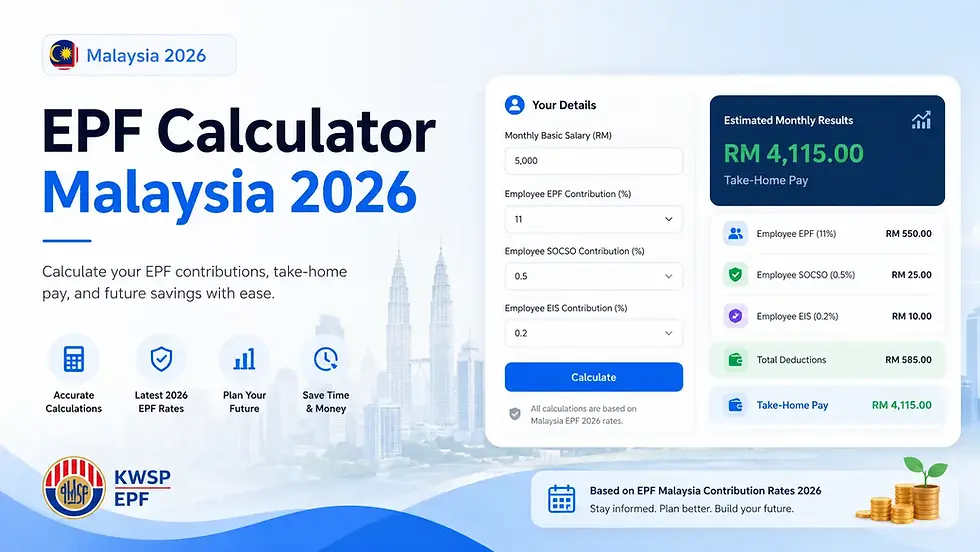
If you want the exact figure for your own salary, our EPF calculator Malaysia tool does the math for you in seconds.
Employers must also remember the deadline. EPF contributions must reach KWSP by the 15th of the following month. Wages paid in October must be contributed by 15 November.
When Should Payroll Change the Rate?
Watch the calendar month after each worker's 60th birthday. A worker who turns 60 on 2 June keeps the normal rates for June. The 0% and 4% rates apply from July wages.
Missing this date is one of the most common payroll mistakes. Paying the old 11% rate for an extra month means deducting money the employee no longer owes, while underpaying the employer share creates a shortfall that KWSP will flag during its checks.
What Is the Maximum Age for EPF Contributions?
The maximum age for EPF contributions is 75.
Once a member reaches 75, no further contributions are allowed. Not from an employer, and not from the member.
Can You Contribute to EPF Until Age 75?
Yes. A member can keep receiving employer contributions and making voluntary contributions right up to the point of turning 75, as long as the person stays within the applicable rules.
What Happens to EPF After Age 75?
Contributions stop completely, but your savings do not disappear. The money stays in your account, keeps earning the annual dividend, and remains withdrawable at any time.
Can You Make Voluntary EPF Contributions After 60?
Your mandatory employee share may be 0%, but nothing stops you from adding money on your own. EPF gives members several ways to do this:
Self contribution (i-Simpan): you transfer money into your own EPF account through i-Akaun, online banking or a KWSP counter. No employer is needed. You can start through the official self contribution page on the KWSP website.
Employee voluntary excess: you ask your employer to deduct more than the statutory rate and send it in with the monthly contribution.
Employer voluntary excess: your employer pays more than the required 4%.
All voluntary contributions are capped at RM100,000 per member per year.
Why bother? Because every extra ringgit keeps earning the EPF dividend, and after 60 you can pull the money out whenever you need it. Few savings tools combine employer top-ups, yearly dividends and total flexibility like this.
Voluntary contributions also stop at age 75, in line with the maximum contribution age.
Can an Employee Aged 60+ Add Their Own Contribution?
Yes. Even though the statutory rate is 0%, a Malaysian employee aged 60 and above can add money through self contribution or voluntary excess deductions arranged with the employer. The same RM100,000 yearly cap applies.
Tax relief on voluntary contributions changes from time to time, so check the current LHDN rules before making a claim.
What Happens to EPF After 60 Years?
Age 60 is a milestone for more than just contribution rates.
When you turn 60, your remaining savings, including anything left in Akaun 55, are brought together into Akaun Emas, the account EPF uses for members in this age group. You also gain full access to your money through the Age 60 Withdrawal. Full details are on the official Age 55 and 60 Withdrawal page.
You have three choices:
Withdraw everything in one lump sum
Withdraw part of your savings and leave the rest to grow
Leave it all in EPF and let the dividends compound
Your money is never locked in after 60. You can withdraw any amount, at any time, as often as you like.
Can I Withdraw EPF at Age 60?
Yes. The Age 60 Withdrawal allows you to take out all or part of your savings, and you can apply any time after turning 60. You can even withdraw while still employed, because working after 60 does not block your withdrawal rights.
What Happens to New Contributions After Age 60?
Every contribution your employer pays after your 60th birthday lands in Akaun Emas, earns the annual dividend, and stays fully withdrawable.
Once you pass 60, EPF behaves like a savings account your employer pays into. Money goes in every month, it earns dividends, and you can take it out whenever you want.
EPF Contribution Before vs After Age 60: What Changes?
Factor | Below 60 (Malaysian) | Age 60 to 75 (Malaysian) |
Employee share | 11% | 0% |
Employer share | 12% or 13% depending on wages | 4% |
Salary deduction | Yes | None |
Where new savings go | Akaun Persaraan, Akaun Sejahtera, Akaun Fleksibel | Akaun Emas |
Withdrawal access | Limited to specific schemes | Full access at any time |
Last contribution age | 75 | 75 |
The current contribution schedule took effect for October 2025 salaries, with November 2025 as the contribution month. Always confirm the latest figures on the KWSP website before you finalise payroll.
What Are the EPF Contribution Rules for 2026?
Here is a summary of the rules that apply in 2026:
For Malaysian employees aged 60 and above, the rates remain 0% employee and 4% employer
The reduced rate begins in the month after the 60th birthday
Mandatory contributions can continue until age 75
Wages of RM20,000 and below use the wage-range table, while higher wages use the percentage method
Employers must remit contributions by the 15th of the following month
PR and non-Malaysian members follow their own rates as shown earlier
EPF reviews the Third Schedule from time to time, so treat the official KWSP portal as the final word on current rates.
Where Can I Download the EPF Contribution Table PDF for Age Above 60?
You can download the complete contribution table as a PDF right here. No login, no digging through the KWSP portal.
The PDF puts the entire current Third Schedule in one clean, print-friendly document. Here is what is inside:
Contribution rates for every age group, including the age 60 and above rates
Full wage ranges from RM10 up to RM20,000 and above
Employee share, employer share and total contribution for each wage band
Separate rates for Malaysian citizens, permanent residents and non-Malaysian members
Why use this version? Because most EPF tables floating around the internet are old. EPF has changed its wage structure, account structure and rates several times in recent years, and an outdated table quietly gives you wrong numbers. This PDF is built from the current schedule and gets a fresh version every time KWSP announces a rate change.
One habit worth keeping: recheck this page whenever EPF announces a schedule update, and download the new file before running payroll. For absolute certainty, you can always compare the figures against the official KWSP mandatory contribution rates page.
Practical Usage: How This Works in Real Life
You are 61 and still working. Encik Rahim is 61 and earns RM3,250 a month as a site supervisor. His payslip shows zero EPF deduction. His employer still sends RM131 to KWSP every month. His take-home pay is higher than it was at 59, and his savings still grow by about RM1,572 a year from the employer share alone.
You run payroll. Puan Faridah handles wages for 40 staff, including three workers above 60. Her routine is simple: switch each worker to the 60+ rates from the month after their birthday, read amounts from the wage-range table for wages up to RM20,000, and remit everything by the 15th of the following month.
You retired, withdrew everything, then went back to work. Mdm Lim withdrew her full savings at 60 and later took a part-time admin job. Her new employer still registers her with EPF and pays the 4% share. The money lands in Akaun Emas, earns dividends, and she can withdraw it any time she wants.
Frequently Asked Questions
Can I contribute to EPF after 60 years old?
Yes. If you are still working, your employer must keep paying the mandatory 4% share until you turn 75, even though your own share is 0% as a Malaysian citizen. You can also add money yourself through self contribution or voluntary excess deductions, subject to the RM100,000 yearly cap.
What is the EPF contribution rate for a 60-year-old employee?
For a Malaysian citizen, it is 0% employee share and 4% employer share. Permanent residents pay 5.5% with a 6% or 6.5% employer share, while non-Malaysian members registered from 1 August 1998 pay 2% plus 2%. The new rate starts from the month after the 60th birthday.
What is the EPF contribution rate for age above 55?
Nothing changes at 55. A Malaysian employee aged 55 to 59 still pays 11%, and the employer pays 12% or 13% depending on wages. The reduced 60+ rates only begin from the calendar month after the 60th birthday.
Can a retired person contribute to EPF?
Yes, even without a job. A retiree can make self contributions through i-Akaun, online banking or a KWSP branch. The combined cap is RM100,000 per year, and contributions must stop once the member reaches 75.
Can I put extra money in EPF?
Yes. You can make self contributions, or ask your employer to deduct an employee voluntary excess on top of the statutory rate. Employers can also choose to pay more than their required share. All voluntary contributions together are capped at RM100,000 per year.
Is there a limit to voluntary EPF contributions?
Yes. The combined limit is RM100,000 per member per year. Once you reach the cap, you wait for the next calendar year. Voluntary contributions also stop permanently at age 75.
Can I withdraw money from my KWSP account at age 60?
Yes. The Age 60 Withdrawal lets you take out everything or just part of your savings, at any time after your 60th birthday. Anything you leave behind sits in Akaun Emas and keeps earning the annual dividend.
How long can I keep money in EPF after retirement?
As long as you want. EPF does not force a withdrawal at 60, 75 or any other age. Savings left in the account continue to earn dividends, and you can withdraw any amount at any time once you pass 60.
Is there an age limit for contributing to EPF?
Yes. The maximum contribution age is 75. After that, neither you nor your employer can pay anything into the account. Your existing savings stay in place and keep earning dividends.
What happens to EPF after 60 years?
Three things change. Your mandatory employee share drops to 0% if you are a Malaysian citizen, your employer's share drops to 4%, and you gain full withdrawal access through Akaun Emas. Contributions can continue until 75, and any money left inside keeps earning dividends.
The Bottom Line
The rules after 60 reward you for staying in the workforce. Your take-home pay rises because the 11% deduction disappears. Your employer still tops up your savings at 4% until you turn 75. And every ringgit in your account, old or new, stays fully withdrawable.
If you want faster growth than the 4% employer share alone, voluntary contributions are your lever. And if you handle payroll, the two dates that matter are the month after each worker's 60th birthday and the 15th of every month.


Comments