M40 Income in Malaysia: Latest Income Range

Most Malaysians judge their income level by feeling. The government does not. It uses a fixed system of three income groups: B40, M40 and T20.
M40 is the middle group. It covers the middle 40 percent of households in the country. Under the latest official survey from 2024, an M40 household earns between RM5,860 and RM12,679 per month.
In this guide, you will learn what M40 income really means, how it is calculated, why the range keeps changing, how it differs by state, and most importantly, how to figure out which group your household actually belongs to.
What Is M40 Income in Malaysia?
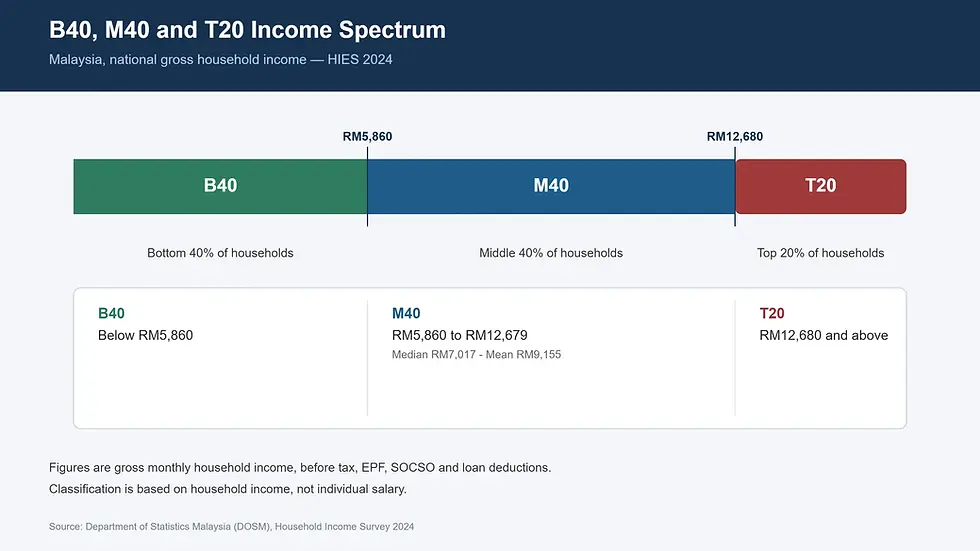
M40 income in Malaysia refers to the middle 40 percent of households ranked by income. Under the latest Household Income Survey 2024, M40 households earn a monthly gross household income of RM5,860 to RM12,679. Households earning below RM5,860 fall under B40, while T20 starts at RM12,680.
The classification comes from the Department of Statistics Malaysia (DOSM), which measures household income through a national study called the Household Income Survey (HIES). The survey runs every two years, and the 2024 edition produced the current thresholds.
Three quick points that clear up most of the confusion:
M40 classifies households, not individuals. Your group depends on the combined income of everyone living under your roof.
The range is a national figure. Income levels differ by state, so the same income can sit differently depending on where you live.
The thresholds move over time. M40 is a position in the income distribution, not a fixed salary band.
What Does M40 Stand For?
M40 simply means Middle 40. DOSM lines up every household in Malaysia from lowest income to highest, then splits them into three blocks.
Group | Position in the country | Share of households |
B40 | Bottom | 40% |
M40 | Middle | 40% |
T20 | Top | 20% |
Think of it like a marathon. Your group is not decided by your finishing time alone. It is decided by where you finish compared with everyone else. Run the same time in a faster field, and you drop down the rankings. That is exactly how these income groups work.
Is M40 Based on Your Salary or Household Income?
Household income, always.
Gross household income includes:
Salaries and wages of every working person in the house
Income from business or self-employment
Rental income
Investment returns such as dividends
Regular transfers received, such as pensions
This is where the most common mistake happens. A fresh graduate earning RM3,500 in Kuala Lumpur might assume she is B40. But if she lives with her parents and the household pulls in RM9,000 a month combined, her household is actually M40.
The logic is simple. Policies like cash aid, subsidies and affordable housing are designed around what a whole household can afford, not what one person's payslip says.
Is M40 the Same as Middle Class?
Close, but not the same thing.
M40 is a mathematical classification. It tells you where your household sits in the national income distribution. Middle class is a broader idea that also considers education, occupation, assets and lifestyle.
Most M40 households would call themselves middle class, and that is fair. But a household at the bottom of M40, earning around RM6,000 with three children in Kuala Lumpur, lives a very different life from an upper M40 household earning RM12,000 in the same city.
What Is the Latest M40 Income Range in Malaysia?
According to the Household Income Survey Report 2024 released by DOSM, the national income thresholds are:
Income group | Monthly gross household income |
B40 | Below RM5,860 |
M40 | RM5,860 to RM12,679 |
T20 | RM12,680 and above |
Three details to keep in mind:
The figures are national. State level distributions differ.
The figures are gross income, before tax, EPF, SOCSO and loan deductions.
The M40 group matches deciles D5 to D8 in DOSM's framework. We break this down later.
For context, the national median household income in 2024 was RM7,017, and the mean was RM9,155. Both sit comfortably inside the M40 range. In plain terms, the typical Malaysian household is an M40 household.
What Is the Minimum Income for M40?
RM5,860 per month in gross household income. One ringgit below that, at RM5,859, the household is classified as B40.
What Is the Maximum Income for M40?
RM12,679 per month. One ringgit more, and the household crosses into T20.
Quick Check: Which Group Does Your Household Fall Into?
Use the table below with your total monthly household income:
Monthly household income | National classification |
RM4,000 | B40 |
RM5,500 | B40 |
RM5,860 | M40 (entry point) |
RM7,000 | M40 |
RM10,000 | M40 |
RM12,679 | M40 (upper limit) |
RM12,680 | T20 |
Remember, this is household income, not your individual salary.
B40 vs M40 vs T20 Income Range
Here is the full picture in one table:
Group | Meaning | Share of households | 2024 national range |
B40 | Bottom 40% | 40% | Below RM5,860 |
M40 | Middle 40% | 40% | RM5,860 to RM12,679 |
T20 | Top 20% | 20% | RM12,680 and above |
Difference Between B40 and M40
The cut-off is RM5,860. Below it, you are B40. At or above it, you are M40.
The practical difference is bigger than the number suggests. Most major assistance programmes, including cash aid like Sumbangan Tunai Rahmah (STR), are built around B40 households. M40 households usually receive limited or conditional support.
If your household income falls below RM5,860, read our full guide on B40 income in Malaysia.
Difference Between M40 and T20
The cut-off is RM12,680.
T20 households pay the largest share of income tax and are excluded from most subsidies. But a T20 household in Kuala Lumpur with two car loans and a mortgage can feel very different from one in a smaller town. The label says top 20 percent. The bank account does not always agree.
For the other end of the scale, see our complete guide on T20 income in Malaysia.
How Do You Know If You Are M40?
Work through these three steps.
Step 1: Add Up Your Total Household Income
Include every earner under your roof and every income source. Salaries, business income, rental, dividends and regular transfers such as pensions all count.
Step 2: Compare It With the National Threshold
Below RM5,860: B40
RM5,860 to RM12,679: M40
RM12,680 and above: T20
Step 3: Consider Your State Context
Because the classification is relative, the same income carries different weight in different states. An RM8,000 household in Kelantan is well above the local norm. The same income in Kuala Lumpur sits closer to the middle.
Examples of Real M40 Households
Example 1: The single earner. Faizal lives alone in Seremban and earns RM6,500 a month. His household income is RM6,500. He is M40.
Example 2: The dual income couple. Aida earns RM4,200 and her husband earns RM5,000. Individually, both are below the M40 entry point. Together, their household income is RM9,200. They are firmly M40.
Example 3: The multi earner family. A father earns RM3,000, his wife RM2,500 from part time work, and their working son RM6,000. The household income is RM11,500. That is upper M40.
Example 4: The stretched T20. A couple in KL earns a combined RM13,000. On paper they are T20. After rent, two children and car instalments, they feel M40 at best.
Notice the pattern. The number of earners, not just the salary, decides the classification. This is why two people doing the same job can belong to different income groups.
Does M40 Income Differ by State in Malaysia?
Yes, and this is where most articles stop short.
The RM5,860 to RM12,679 range is the national figure. DOSM also publishes state level data, and the gaps are wide.
State | Median monthly household income (2024) |
Malaysia (national) | RM7,017 |
Kuala Lumpur | RM10,805 |
Putrajaya | RM10,769 |
Selangor | RM10,726 |
Johor | RM7,712 |
Penang | RM7,386 |
You can verify these numbers in the official HIES 2024 findings published by DOSM.
What the table tells you:
In Kuala Lumpur, Putrajaya and Selangor, the median household itself sits near the top of the national M40 band. Half the households there earn around RM10,700 or more.
In states with lower medians, an RM8,000 household income is well above the typical local income.
Why does this matter to you? Because the cost of living does not follow the national average. Housing, tolls and childcare in the Klang Valley can swallow an M40 income whole, while the same income in a smaller town supports a fairly comfortable life.
So when someone says "M40 but living like B40", this is usually what they mean. The label is national. The bills are local.
M40 Income Range Over the Years: 2019, 2022 and 2024

If you search for M40 income today, you will still find many articles quoting RM5,250 to RM11,819. That was the 2022 figure. The range has since moved.
Survey year | B40 | M40 | T20 |
2019 | Below RM4,850 | RM4,850 to RM10,959 | RM10,960 and above |
2022 | Below RM5,250 | RM5,250 to RM11,819 | RM11,820 and above |
2024 | Below RM5,860 | RM5,860 to RM12,679 | RM12,680 and above |
Why Did the M40 Income Range Change?
Because B40, M40 and T20 are relative classifications.
Each survey lines up all households again and re-splits them. When incomes rise across the country, the thresholds rise with them. When the distribution shifts, the bands shift too.
This leads to an insight most people miss. Moving from B40 into M40 does not always mean your household got richer in real terms. It can simply mean the whole country's income rose and the cut-off points moved up.
This is also why the government keeps reviewing how it targets aid, and why the PADU database was introduced. A single income band cannot capture everything about a household's situation.
M40 Income by Decile: D5 to D8
DOSM divides households into ten equal blocks called deciles. D1 is the poorest 10 percent. D10 is the richest 10 percent. M40 covers deciles D5 to D8.
Decile | Approximate monthly household income (2024) |
D5 | RM5,860 to RM7,019 |
D6 | RM7,020 to RM8,599 |
D7 | RM8,600 to RM10,279 |
D8 | RM10,280 to RM12,679 |
Why does this layer of detail matter? Because two households can both be M40 yet live completely different financial lives. A D5 household at RM6,500 and a D8 household at RM12,000 share a label but not a budget. When people say the M40 group is squeezed, they usually mean the D5 and D6 households, which face city level costs with far less room to absorb them.
Why M40 Income Often Feels Tight
Here is the part most articles skip. Being M40 on paper does not guarantee comfort in practice. Four factors explain the gap.
Household Size
RM10,000 for a married couple without children is a different world from RM10,000 supporting four children and two elderly parents. The classification counts income. It does not count mouths.
Where You Live
The same income meets very different costs in Kuala Lumpur, Johor Bahru, Kuching or Alor Setar. Housing alone can take up 30 to 50 percent of an M40 income in major cities.
Debt and Fixed Commitments
Gross income ignores your car loan, home loan, PTPTN and credit card bills. A debt free M40 household can live better than a heavily indebted T20 one.
Gross Income vs Disposable Income
Your classification is based on gross income. What you actually spend is disposable income, which is what remains after tax, EPF, SOCSO and deductions. For many M40 households, the gap between the two is where the monthly stress lives.
M40 households often earn too much to qualify for most aid, and too little to feel financially free. That squeeze is the defining feature of the group.
What Government Support Can M40 Households Get?
The honest answer: less than B40, more than you might think, and it depends on each programme.
Cash aid (STR, SARA): Largely reserved for B40 households. Most M40 households do not qualify.
Healthcare: Public hospital treatment stays heavily subsidised for everyone, including M40.
First home purchases: Stamp duty exemptions for first time buyers of homes priced RM500,000 and below have directly benefited many M40 households.
Tax reliefs: Available to all taxpayers, and M40 households usually have enough taxable income for reliefs to make a real difference.
Targeted subsidies: The government is moving toward subsidies that look at household data through PADU. Keeping your PADU profile updated matters more than your B40, M40 or T20 label.
You may have also heard of T15, a proposed top 15 percent category discussed in subsidy reform debates. It is not an official DOSM classification yet.
The key principle: your income group does not automatically decide your eligibility. Each scheme sets its own criteria, and some use per capita income or other filters instead of household income.
Practical Usage: How to Use Your M40 Classification
Knowing your group only helps if you do something with it. Here is how:
Check eligibility before assuming. When new aid or subsidies are announced, read the actual criteria. Do not assume M40 means no, or that B40 means yes.
Budget for self-reliance. M40 households sit outside most safety nets. An emergency fund of three to six months of expenses, plus proper insurance coverage, matters more for you than for most.
Use the numbers in salary conversations. The national median household income is RM7,017. Knowing where your household sits gives you honest context for career and income decisions.
Check affordable housing income caps. Many affordable housing schemes set income ceilings that fall inside the M40 band. Know your total household income before applying.
Recalculate after life changes. Marriage, a new job, a child starting work, or a parent moving in all change your household income and possibly your group.
Frequently Asked Questions About M40 Income
How much does M40 earn in Malaysia?
An M40 household earns RM5,860 to RM12,679 per month in gross household income, based on the latest HIES 2024 national classification. This represents the middle 40 percent of Malaysian households.
How do I know if I am B40 or M40?
Add up the gross income of every earner in your household, including salaries, business income and other sources. Below RM5,860 means B40. RM5,860 to RM12,679 means M40.
Is RM4,000 a good salary in Malaysia?
As a household income, RM4,000 falls under B40 at the national level. As an individual salary, it depends on your household. If others in your home also earn, your combined income could place you in M40. Location and the number of dependants also decide how far RM4,000 goes.
Is M40 middle class?
Roughly, yes. M40 covers the middle 40 percent of households and overlaps heavily with what people call middle class. But M40 is a statistical income category, not a full measure of lifestyle or wealth.
Does M40 qualify for government aid?
Mostly no for major cash aid such as STR and SARA, which target B40. However, M40 households benefit from public healthcare subsidies, certain tax measures and first home stamp duty exemptions. Each programme sets its own criteria.
Does the M40 income range change over time?
Yes. DOSM recalculates the bands with every survey. The M40 range was RM5,250 to RM11,819 in 2022 and RM5,860 to RM12,679 in 2024.
What is upper class income in Malaysia?
At the national level, T20 begins at RM12,680 in monthly gross household income. True upper class status also depends on wealth, assets and location, not just monthly income.
Is M40 based on individual salary?
No. It is based on total gross household income, which combines the income of everyone living in the same household.



Comments