NGO Tax Deduction Application Criteria Malaysia: Section 44(6) Requirements & How to Apply

Your NGO is registered. You run real charity programmes. So your donors can claim tax relief automatically, right?
Wrong. In September 2026, LHDN reminded the public that tax deduction approval is not automatic for any non-profit organisation. Registration makes your NGO legal. It does not make donations to your NGO tax deductible. That status comes only from approval under Subsection 44(6) of the Income Tax Act 1967, which must be applied for, evaluated, and approved by the Director General of Inland Revenue (The Star).
If you lead or manage an NGO in Malaysia, this guide is for you. You will learn what Section 44(6) approval is, the exact criteria LHDN evaluates, the documents you must prepare, the step by step application process, and what you must do after approval to keep it.
What Are the NGO Tax Deduction Application Criteria in Malaysia?
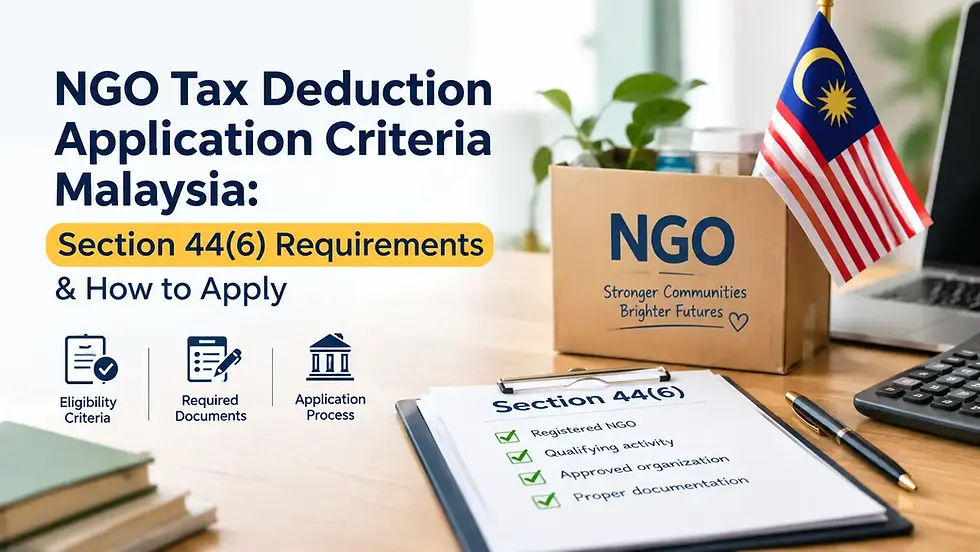
The NGO tax deduction application criteria in Malaysia require an organisation to be legally registered, operate for non-profit purposes under Section 44(7), benefit the Malaysian public, avoid private gain, have more than 50% external board members, show 24 months of operation, and hold a Tax Identification Number before applying to LHDN.
The criteria fall into six groups:
Legal status: registered in Malaysia with SSM, ROS or another recognised registrar
Purpose: non-profit objectives, with activities that match them and fit Section 44(7)
Public benefit: open to the Malaysian public, with no private or insider gain
Governance: more than 50% external members on the board
Track record: at least 24 months of operation plus a Tax Identification Number
Documentation: complete supporting documents submitted through LHDN's e-Derma system
Now let's unpack each part.
What Is NGO Tax Deduction Approval Under Section 44(6)?
Subsection 44(6) of the Income Tax Act 1967 gives the Director General of Inland Revenue (DGIR) the power to approve an institution, organisation or fund (IOT) so that donations to it become tax deductible for donors.
Once approved, two things happen:
Donors get relief. Individuals and companies that donate money to your NGO can deduct the donation from their taxable income, limited to 10% of aggregate income. It is a deduction, not a rebate and not a cash refund.
Your NGO gets tax exemption. Approved bodies enjoy income tax exemption on the income they receive, subject to conditions.
Why does this approval exist at all? Because every ringgit donated and deducted reduces the tax the government collects. So LHDN only extends this privilege to organisations that prove they truly serve the public.
"It is not an automatic status. Every application is evaluated based on objectives, actual activities, constitution, governance, and the IOF's compliance with stipulated conditions."
Julie Adila Mat Hassan, Director, Tax Policy Sector Approval and Monitoring Division, LHDN
Here is the distinction that trips up most applicants:
NGO registration does not equal Section 44(6) approval.
Registering with ROS (societies), SSM (companies) or BHEUU (trusts) proves your organisation exists in law. Section 44(6) approval proves your organisation serves the public in a way that justifies giving up tax revenue. These are two separate statuses granted by two separate processes.
Who Can Apply for Section 44(6) Approval in Malaysia?
LHDN groups eligible applicants into three types.
Institutions
Institutions are established bodies with a formal structure. Common examples include:
Hospitals and medical centres not run for profit
Public welfare and charitable institutions
Universities, colleges and schools
Disease research institutions
Technical or vocational training institutions
Think of a non-profit hospital providing free treatment to low income patients. That is an institution in LHDN's eyes.
Organisations
Organisations are bodies set up for purposes recognised under Section 44(7). Eligible purposes include educational assistance, relief of hardship, religious purposes, cultural activities, animal welfare, environmental protection and national unity.
An association running food aid programmes for the urban poor is an example of an organisation.
Funds
A fund is money set aside for one specific purpose, usually established by an institution or organisation. An example is a fund for cancer treatment costs of poor patients.
The key point: a fund is assessed separately from the body that created it. The fund's objective must be specific and clearly stated in its establishing document.
One important note. Your entity type decides which LHDN document checklist applies to your application. The requirements differ for SSM companies, ROS societies, BHEUU trusts and funds.
The 10 NGO Tax Deduction Application Criteria LHDN Evaluates
This is the heart of your application. Here is a quick view, then the details.
# | Criterion | What you must show |
1 | Malaysian registration | Valid registration with SSM, ROS, BHEUU or another registrar |
2 | Non-profit objectives | Constitution states clear non-profit aims |
3 | Activities match objectives | Real programmes line up with your stated aims |
4 | Eligible purpose | Activity falls under Section 44(7) |
5 | Public benefit | Open to a sufficient section of the public |
6 | No private benefit | No insider gain |
7 | Governance | More than 50% external board members |
8 | Operating history | At least 24 months of operation |
9 | Tax registration | Valid Tax Identification Number |
10 | Receipt readiness | Donation practices meet the rules |
1. Your NGO Must Be Registered in Malaysia
Your organisation must be legally established under Malaysian law. Where you register depends on your structure:
SSM: companies, including Companies Limited by Guarantee
ROS / JPPM: societies and associations
BHEUU: trusts and foundations
Other registrars recognised under written Malaysian law
LHDN checks your registration certificate and governing documents first. Prepare certified copies of your registration, constitution and latest annual returns before anything else.
2. Your Objectives Must Be Non-Profit
Your constitution must show that the organisation is not established for profit.
LHDN reads your constitution before anything else. Vague objectives like "to do good works" weaken your application. A specific objective like "to provide educational support to underprivileged children in Selangor" strengthens it.
Why does this matter so much? If your constitution allows profit distribution to members, your application fails at the first reading. LHDN will not grant tax privileges to a body that can lawfully pocket its surplus.
3. Your Activities Must Match Your Objectives
What you actually do must line up with what your constitution says. LHDN evaluates this chain:
Constitutional objective → actual programme → beneficiary → spending → evidence
If your objective is rural education, LHDN expects activity reports showing education programmes, records of the students helped, and spending on educational activities.
Mismatch is one of the most common rejection reasons. An NGO that declares education objectives but spends most of its funds on events and merchandise raises red flags fast.
Prepare activity reports, beneficiary lists and expenditure summaries for each programme.
4. Your Purpose Must Fall Under Section 44(7)
"We are a charity" is not enough. Your activities must fit a category LHDN recognises.
Purpose | What it covers | Example NGO activity |
Relief of hardship | Poverty and hardship assistance | Food aid for low income families |
Education | Educational assistance and facilities | Scholarships and school support |
Health | Medical and welfare activities | Free community health screenings |
Religion | Religious purposes | Maintenance of religious facilities |
Environment | Environmental conservation | River clean-ups and tree planting |
Animals | Animal welfare and conservation | Animal rescue and shelters |
Culture | Cultural and artistic activities | Heritage and arts programmes |
National unity | Community integration | Unity building community projects |
Medical treatment | Serious medical treatment assistance | Funds for patients' treatment costs |
Sections 44(7A) and 44(7B) cover other specific cases, such as gifts to the government and approved sports funds. Most NGOs apply under the Section 44(7) categories above.
5. Benefits Must Be Open to the Public
Your objectives must not limit benefits to a narrow private group based on race, religion, ancestry or closed membership.
This does not mean every single Malaysian must benefit. The guideline looks at whether a sufficient section of the public can benefit. A charity serving orphaned children qualifies, because orphans are a public category, not a private club.
But an association that only helps its own members or their relatives would fail this test. Programmes benefiting non-Malaysians in Malaysia may need prior approval, so check the guideline if your beneficiaries include foreigners.
6. No Private or Insider Benefit
Your funds and resources must not benefit insiders. Insiders include founders, trustees, directors, committee members, people operating the organisation, their families and connected parties.
Red flags include:
Paying above market rates to companies owned by committee members
Assistance flowing mainly to relatives of office bearers
Organisation assets used for personal purposes
LHDN is strict here for a simple reason. Tax deductible donations are public money in effect. Diverting them to insiders destroys the public purpose that justifies the tax benefit.
7. More Than 50% of Your Board Must Be External
Under the current guideline, more than 50% of your board of directors, trustees or committee must consist of external members.
An external member has no connection to the organisation, its founder or its operations. That means:
No close family relationship with founders or key office holders
No employment or directorship with the NGO
No financial interest in the organisation
No membership ties that create control
A practical tip: invite independent professionals such as accountants, lecturers, doctors or retired civil servants to join your board. Keep a simple register showing each member's status with signed declarations. The exact composition rules can differ slightly between ROS societies, SSM companies and BHEUU trusts, so check the guideline appendix for your entity type.
8. You Need at Least 24 Months of Operation
Institutions and organisations generally must show at least 24 months of actual operation before applying.
Why? LHDN wants a track record, not just registration papers. Two years of activity reports, financial records and audited accounts prove the organisation is real and functioning.
If your NGO is new, use the first two years to build your record. Run programmes, keep clean accounts, document everything, then apply.
9. You Must Have a Tax Identification Number
You need a valid Tax Identification Number (TIN) registered with LHDN. You can register through e-Daftar on the LHDN website, and your TIN links to your MyTax account.
The logic is simple. Section 44(6) approval is a tax status. LHDN cannot process an application from a body that does not exist in the tax system.
10. Your Donation Practices Must Meet Receipt Rules
Approval is not a licence to issue receipts for anything. To qualify for tax deductible treatment:
Donations must be in money (goods and services do not qualify)
No repayment or refund conditions
Not a loan or financial arrangement
No interest paid to donors
No exchange of benefits, meaning the donor receives nothing in return except the receipt
No donor conditions that conflict with your approved objectives
Set up proper receipt books or an e-receipt system before you apply. LHDN evaluates whether your donation handling can comply with the rules.
Practical Example: Two NGOs, Two Outcomes
NGO A registered as a society and applied after 8 months. The board consisted of the founder, his wife and his brother. The constitution stated one vague objective: "to help people in need." Activities were a few ad hoc events with no financial records. The result was rejection. The application failed the operating history rule, the governance rule and the objectives rule.
NGO B registered, then spent 24 months running a tuition programme for underprivileged children. They kept monthly activity reports, clean accounts and audited statements. They rebuilt the board so that more than half the members were independent professionals, and rewrote the constitution with specific objectives. The result was approval, and fundraising became easier because donors could claim tax relief.
The lesson is simple. LHDN rewards preparation, not just good intentions.
What Should Your NGO's Constitution Contain?
Your constitution is the rulebook of your organisation. LHDN studies it closely because it is the legal proof of your public purpose. It should clearly cover:
Purpose and objectives: why the organisation exists, who it benefits and how
Beneficiaries: who receives support and how the benefits reach them
Governance: how meetings are called, how office bearers are appointed, who holds decision making power
Financial controls: who authorises spending, how assets are managed, how misuse is prevented
Audit and accounting: your accounting period, audit process and reporting duties
Dissolution: where assets and funds go if the organisation closes
Amendments: how the constitution can be changed
One warning. After approval, changes to the constitution need LHDN approval before you file them with your registrar. Changing the rules first and informing LHDN later can cost you your status.
What Documents Do You Need for the Application?
Document | Why LHDN needs it |
Registration certificate | Confirms legal status |
Constitution or memorandum and articles | Shows objectives and governance |
Activity reports and programme details | Proves real operations matching objectives |
Financial statements or audited accounts | Shows financial accountability |
Board and committee member list | Verifies external member composition |
TIN confirmation | Links you to the tax system |
Licences for specific activities | Required for care homes, health services and similar facilities |
Contact details | Official address, phone and email for correspondence |
Two extra points to remember.
First, NGOs running elderly care centres, orphanages, OKU facilities or healthcare services need additional licences from the relevant ministries or departments. Include these in your application.
Second, LHDN publishes separate document checklists for SSM companies, ROS societies, BHEUU trusts and funds. Download the current guideline PDF from the LHDN website and match the checklist to your registration type.
How to Apply for Section 44(6) Approval: Step by Step
Step 1: Run a self check. Go through the 10 criteria honestly. Fixing weak areas before you apply saves months of delay.
Step 2: Read the latest guideline. The current general guideline for institutions, organisations and funds is dated 23 October 2025. Older versions circulating online are superseded, so always work from the latest document on the LHDN website.
Step 3: Prepare your documents. Use the checklist for your registration type. Get certified copies where required.
Step 4: Prepare the application. Decide who is authorised to sign on behalf of the organisation. Prepare a cover letter stating your organisation's details and the purpose of the application.
Step 5: Submit through e-Derma. Since 15 June 2026, new applications must be submitted online through the e-Derma system on the MyTax portal. You upload your documents digitally, so no office visits are needed. One exception applies during the transition: applications filed through tax representatives or tax agents may still be submitted manually for now.
Step 6: Submit everything complete. Incomplete files stop processing entirely. Cross check every item against your checklist before submitting.
Step 7: Wait for evaluation. LHDN reviews your objectives, activities, constitution, governance and compliance. They may request more information, so respond promptly.
Step 8: Receive your approval letter. The letter states your approval reference, effective date, approval period and any special conditions. Keep it safe, because you need the reference number on every donation receipt you issue.
What Happens After Your NGO Gets Approval?
Your approval letter
The letter contains your approval reference, the effective date, the approval period, and any conditions or restrictions attached. Read the conditions carefully. They are binding, not suggestions.
Your donation receipts
Every receipt you issue must show:
Your NGO's name and address
A unique preprinted serial number
The receipt date
Donor details
The donation amount
The designation of the person collecting the donation
The Subsection 44(6) approval reference
The validity period of your approval
Donors rely on these receipts as proof when filing their taxes. Receipts missing the approval reference create problems for your donors at filing time.
e-Invoice rules
LHDN treats e-Invoice documentation separately from traditional preprinted receipts. If you issue e-Invoices, follow the current LHDN e-Invoice guidance for donations. Do not assume your existing receipt format covers it.
What You Must Do After Approval to Keep It
Approval is conditional. Break the conditions and LHDN can revoke your status. Your main obligations:
Spend donations on your mission. The current guideline sets a minimum spending ratio of 50% of approved donations on eligible activities. A higher 60% ratio applies where the organisation holds large accumulated funds or uses funds for business purposes. Read the current guideline for the exact thresholds that apply to you.
Situation | Minimum spending on eligible activities |
General rule for approved donations received | 50% |
With significant accumulated funds or funds used for business | 60% |
Keep proper records. Maintain accounts, donor records, beneficiary records and activity records.
Submit what LHDN asks for. File your audited financial statements and tax documents as required.
Report changes. Notify LHDN in writing about changes to your board, membership, constitution, address, assets, and any plans for dissolution. Some changes need approval before you make them.
Why is LHDN so strict? Your status lets the public claim tax relief. LHDN runs regular compliance audits to protect that system, and any approved body found breaking the rules can lose its approval.
Why Do Section 44(6) Applications Get Rejected?
Based on LHDN's guidance, common rejection reasons include:
Objectives that are too broad, vague or unsuitable
Activities that do not match the stated objectives
A profit motive or private benefit in the structure
Benefits limited to a closed private group
A board that fails the external member rule
Less than 24 months of operation
Missing or incomplete documents
A purpose that falls outside the Section 44(7) categories
Go through this list before you apply. Every item here is fixable with preparation.
What Can Cause LHDN to Revoke Approval?
Approval can be withdrawn after it is granted. Causes include:
Failing to submit required financial statements or tax filings
Misusing donation receipts or issuing them incorrectly
Running activities inconsistent with approved objectives
Engaging in prohibited political activities
Allowing private benefit or misuse of funds and assets
Sending funds overseas without approval
Money laundering or other breaches of conditions
Note the difference. Rejection happens before approval because your application falls short. Revocation happens after approval because you failed to comply. Both end the same way: no more tax deductible status.
How Long Does Section 44(6) Approval Last?
Under the current guideline, approval is granted for a limited period of up to 5 years.
To continue the status, submit your extension application in writing within the 6 months before your approval expires, together with updated supporting documents. Your compliance record during the approval period affects the renewal decision, so treat every year as part of your renewal application.
Your approval letter also states an effective date. Receipts must show the validity period, so donors can confirm their donations fall inside the approved window.
How Does Section 44(6) Approval Benefit Your Donors?
Approval changes the fundraising game for your NGO. A tax deductible donation in Malaysia is only valid when the receiving organisation holds current Section 44(6) approval. Once you are approved:
Donations in money to your NGO become tax deductible for donors
The deduction is limited to 10% of the donor's aggregate income
Donors need your official receipts as proof
Donors should still verify your approval status before giving
Your NGO (approval side) | Your donor (deduction side) |
Applies for and maintains approval | Checks the approval status |
Issues official receipts | Keeps the receipts |
Follows compliance rules | Claims the deduction in the tax return |
Renews approval on time | Verifies validity before donating |
For the full donor side rules, limits and claiming steps, read our guide on donation tax relief and deduction in Malaysia.
How to Check Whether an NGO Is Approved
Use the Donation Approval Check tool on the LHDN website. You can search by organisation name and confirm the Subsection 44(6) status and validity period.
Do not rely on posters or social media claims. Even organisations that once held approval can lose it, and expired approval means donations no longer qualify for deduction.
What Changed for NGO Tax Deduction Applications in 2026?
The biggest change is procedural:
From 15 June 2026, new Section 44(6) applications must be submitted online through the e-Derma system on the MyTax portal
Supporting documents are uploaded digitally, with no office visits needed
Applications filed through tax representatives or tax agents may still be submitted manually during this transition phase, with e-Derma expanding to them later
LHDN continues compliance audits and e-Invoice developments
Always confirm the current submission instructions on the LHDN website before you apply, because the process is still being phased in.
Frequently Asked Questions About NGO Tax Deduction Application Criteria in Malaysia
What are the requirements for an approved donation tax deduction in Malaysia?
From the NGO side: register in Malaysia, run non-profit activities under Section 44(7), benefit the public, have more than 50% external board members, operate for at least 24 months, hold a TIN, then apply for Subsection 44(6) approval. From the donor side: donate money to an approved organisation, keep the official receipt, and claim the deduction when filing taxes.
What are the tax requirements for non-profit organizations in Malaysia?
A non-profit must register with a recognised registrar, obtain a TIN from LHDN, keep proper accounts and file its income tax returns. Once approved under Section 44(6), the organisation enjoys income tax exemption on its income but must keep meeting LHDN's conditions, including spending ratios and reporting duties.
How do you check approved donations in Malaysia?
Use the Donation Approval Check tool on the LHDN website. Search the organisation's name and confirm its Subsection 44(6) status and validity period. Do not rely on posters or social media claims, because approvals can expire or be revoked.
What is the LHDN donation tax deduction under Subsection 44(6)?
It is the provision in the Income Tax Act 1967 that lets the Director General of Inland Revenue approve institutions, organisations and funds. Donations in money to approved bodies are tax deductible for donors, limited to 10% of the donor's aggregate income. It is a deduction from income, not a rebate or cash refund.
What is the list of approved institutions under Section 44(6)?
There is no single permanent public PDF list worth relying on. Third party lists online go outdated quickly because approvals expire, get revoked or get renewed. The official and current source is LHDN's Donation Approval Check on its website.
What are the criteria for tax deduction?
For NGOs, the criteria cover registration, non-profit objectives, eligible activities under Section 44(7), public benefit, governance with more than 50% external members, 24 months of operation and a TIN. For donors, the criteria are donating money to an approved organisation and holding an official receipt, with the deduction capped at 10% of aggregate income.
What are the changes to charitable deductions in 2026?
The main change is procedural. From 15 June 2026, new Section 44(6) applications must go through e-Derma on the MyTax portal, with documents uploaded digitally. Applications filed by tax agents remain manual during the transition. Confirm current LHDN instructions before applying.
Conclusion
Section 44(6) approval is earned, not given. Your NGO must be registered, genuinely non-profit, active for at least 24 months, publicly beneficial and properly governed before LHDN even considers the file. Then you must keep complying to hold the status.
The reward is worth the effort. Approved NGOs raise funds more easily because donors can claim tax relief, and the organisation itself enjoys income tax exemption on its income.
Disclaimer: This article provides general information based on LHDN guidance current as of September 2026. It is not professional tax or legal advice. Requirements may change, so verify the latest LHDN guidelines before submitting an application.


Comments